
Bat Removal and Exclusion in Michigan
Help for bats in the attic or walls, from finding how they get in to timing the exclusion around the summer maternity season.
Calls route by ZIP to an independent operator where one covers the address; where none does, they come to Local Core Group, which runs this site.
Bats in a Michigan attic come with a calendar attached. Many bats are federally protected, and the U.S. Fish and Wildlife Service says exclusion should never happen during the maternity season, typically May 15 to August 15, when a colony may include pups that cannot fly yet. The job is getting the bats out through one-way doors and closing every gap behind them, outside that window.
How are bats removed from a Michigan attic?
By exclusion. One-way doors go over the openings the bats use, the bats leave at dusk to feed and cannot get back in, and the openings are then sealed. The U.S. Fish and Wildlife Service says exclusion should never happen during the maternity season, typically May 15 to August 15, and the CDC warns that bat-proofing between May and August can trap young bats inside.
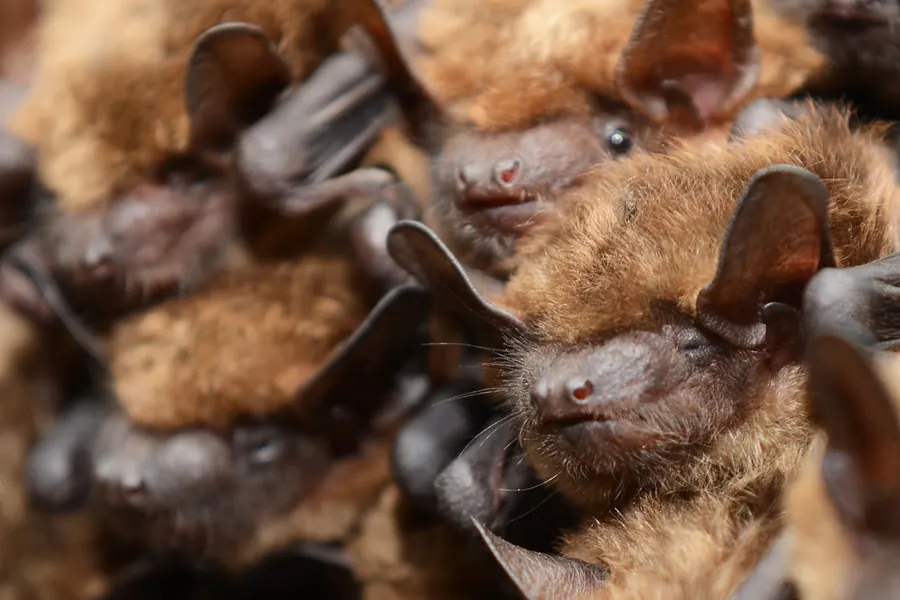
How do you know it is bats and not something else?
Bats give themselves away at dusk, when they come out to feed. The CDC suggests watching where they exit at that hour, because that may show how they are getting inside.
Inside, look for stains, droppings and sound. A Forest Service survey protocol lists dark body-oil and urine stains on walls and near ceilings, droppings and insect parts as signs of bats, and says to listen for the sounds they make. The U.S. Fish and Wildlife Service says little brown bat maternity colonies are commonly in warm sites in buildings, attics among them. The Internet Center for Wildlife Damage Management’s bat damage identification guide shows what bat droppings look like; photograph any you find for the call rather than sweeping them up. The CDC advises that large amounts of bird or bat droppings be cleaned up by professional companies that specialize in hazardous waste removal, and the health section below explains why.
When can bats be excluded in Michigan?
Outside the maternity season. The U.S. Fish and Wildlife Service says exclusions should never happen during the maternity season, typically May 15 to August 15. Big summer groups of bats are almost always pregnant and nursing females that come back to the same colony each year, the Service says, and the pups cannot fly at first. The National Park Service warns that evicting the mothers can leave pups that cannot yet fly or catch food to starve.
The CDC’s advice points the same way. Most bats leave in the fall or winter to migrate, which makes those the best times to bat-proof a home, and anyone bat-proofing between May and August has to be careful not to trap young bats inside.
| Period | What the bats are doing | What it means for the attic |
|---|---|---|
| Typically May 15 to August 15 | Maternity season; pups may not be able to fly yet | USFWS says exclusion should never happen. Find the openings and wait |
| Late summer, after the maternity season | Young can fly; colonies begin to disperse | One-way doors, then sealing |
| Fall and winter | Bats migrate or hibernate; some that stay in Michigan hibernate in buildings | Bat-proofing season, after confirming none are still inside |
The last row matters. At Sleeping Bear Dunes, the National Park Service says the bats that do not migrate hibernate there over the winter in caves or buildings, so a house that looks empty in January may not be. If bats are found hibernating, the U.S. Fish and Wildlife Service says to leave them until spring, because a surprise eviction in winter can kill them.
The Michigan bat guide goes through these dates in more detail.
What does bat exclusion involve?
One-way doors first, then sealing once the bats are out. A Forest Service protocol puts it the same way: bats should be allowed to leave the roost but kept from coming back, and entrances are closed when the bats are absent.
- Find every opening. The CDC says bats can fit through openings as small as a quarter inch, and the Forest Service protocol gives the same 1/4 inch for crevices.
- Put one-way doors on the openings the bats use. The bats leave to feed and cannot come back through.
- Close the other gaps too, including any opening between the attic and the rooms below. The U.S. Fish and Wildlife Service advises sealing openings between roost areas and living spaces to prevent possible rabies exposures.
- Remove the doors and seal those openings once the bats are out.
Many bats are federally protected, and the U.S. Fish and Wildlife Service warns that mishandling or killing them can bring penalties. Two species found in Michigan, the Indiana bat and the northern long-eared bat, are listed as endangered under the Endangered Species Act. The U.S. Fish and Wildlife Service proposed listing the tricolored bat as endangered in September 2022 and is still assessing the status of the little brown bat, which often uses buildings.
See wildlife exclusion for how the same approach works on squirrels, raccoons, mice and birds.
Bat exclusion pricing is covered in the attic animal removal cost guide.
Who is allowed to do bat work in Michigan?
The northern long-eared bat’s endangered listing does not stop bats being removed from homes. When the northern long-eared bat was listed as endangered, the U.S. Fish and Wildlife Service said people can still remove bats from houses, though extra coordination with the Service may be needed, and it encouraged having the work done safely and humanely by a trained professional such as a wildlife or pest exclusion company. The same rule lists unauthorized exclusion from a building the species roosts in, where it results in a take (a legal term covering harassing, harming, trapping or killing), as a possible violation of federal law.
The Service also notes that federal rules do not override stricter state or local laws. When an operator calls you back, ask which state permits cover bat work in a house, and how they will confirm no bats are left inside before the last opening is sealed. For Michigan’s rules, see the DNR’s wildlife damage and nuisance control permits page and its bats page.
Are bats in the attic a health risk?
Two separate risks, with different responses.
Rabies. In Michigan, bats are the animal most often found with rabies, according to the Michigan Department of Health and Human Services (MDHHS). MDHHS maps show 42 rabid bats in Michigan in 2025 and 59 in 2026 as of October 29. The USGS says fewer than one percent of bats contract rabies, but that bats should not be handled, especially ones that are active in daylight and look sick. If a bat may have touched a person, the CDC says to talk to your health department; the bat in the house page covers what to do with the bat itself.
Droppings. Histoplasmosis comes from breathing spores of a fungus that lives in soil and spreads in bird and bat droppings that mix in soil, according to the CDC. The CDC advises that large amounts of bird or bat droppings be cleaned up by companies that specialize in hazardous waste removal. The attic cleanup page covers that work.
Some county health departments decide whether a bat that touched someone is tested; Kent County, for one, tests a bat only when its staff find a possible risk to a person. The health department lookup lists the departments whose pages this site has read, with their contacts.
Common questions
Can I seal the holes myself to get bats out?
Only once the bats are out, and only outside the maternity season. Sealing an opening while bats are inside traps them in the house, and the CDC warns that bat-proofing between May and August can trap young bats inside. The order is one-way doors first, then sealing. Some bats are federally protected, and the U.S. Fish and Wildlife Service encourages having removal done by a trained professional.
Why can’t bats be excluded in summer?
Summer is when bats raise their young, and the U.S. Fish and Wildlife Service says little brown bats often form maternity colonies in attics. The pups cannot fly for their first weeks, and the National Park Service warns that evicting the mothers then can leave the pups to starve. The Service says exclusion should never happen during the maternity season, typically May 15 to August 15.
How small a gap can a bat get through?
A quarter inch, according to the CDC, and a Forest Service survey protocol gives the same 1/4 inch for crevices. The CDC says watching where bats exit at dusk may show how they are getting inside.
Sources for this page
Each rule and figure on this page comes from one of these pages, read on the date given. Agency guidance is described as guidance; it is not presented as law.
- Five methods to safely remove a bat from your homeUSFWS (Midwest Region Office of Communications)
- How (and whether) to install bat boxesUSFWS
- Preventing Rabies from BatsCDC
- Northern long-eared bat (Myotis septentrionalis)USFWS
- Bats and Buildings Enclosure 1 (survey protocol and direction for bats in buildings)USDA Forest Service (Region 6) / BLM bat work group
- Little Brown Bat (Myotis lucifugus)USFWS
- Bats - Jewel Cave National MonumentNPS (Jewel Cave National Monument)
- Tricolored Bat (Perimyotis subflavus)USFWS
- Where do bats live?USGS
- Bat Monitoring at Sleeping Bear Dunes, 2015–2019NPS (Great Lakes Inventory & Monitoring Network)
- Indiana Bat (Myotis sodalis)USFWS
- 50 CFR 17.11 Endangered and threatened wildlife (List table)eCFR (Office of the Federal Register / GPO)
- Endangered and Threatened Wildlife and Plants; Endangered Species Status for Northern Long-Eared Bat (87 FR 73488, Nov. 30, 2022)USFWS (Federal Register)
- RabiesMDHHS
- -2025- Rabies Positive Animals in MichiganMDHHS (map also carries MI DNR and MDARD logos)
- Rabies Positive Animals in Michigan: 2026 (map)MDHHS
- Are bats dangerous?USGS
- About HistoplasmosisCDC
- Reducing Risk for HistoplasmosisCDC
- Rabid bat bulletin (May 28, 2026)Kent County Health Department
Michigan DNR pages
Linked for further reading. This page does not quote them or rely on them for its facts.
- Bats (Nuisance wildlife)
- Bat roost monitoring effort returns for second summer (news release, June 16, 2026)
- Bats
- Wildlife Damage and Nuisance Control Permits
- Wildlife Damage and Nuisance Animal Control application and permit (form)
- Nuisance wildlife
- MDARD, MDHHS, and MDNR Recognize World Rabies Day, September 28
Accuracy and corrections
- Last reviewed
- , by Local Core Group, which runs this site
- How pages are made
- How this site's pages are written and checked
- Sources
- All sources and the dates they were read: sources page
This page is general information for Michiganders, not legal advice. Rules are taken from the agency that publishes them and linked to its own page; agency guidance is labeled as guidance, not law. Rules and guidance change, so check the linked page, the DNR or your local health department before acting on anything time-sensitive.
Corrections. If a rule, number or contact here is out of date, point to the agency page that shows it through the request form or by calling 616-512-2425. Each correction is checked against the source, and the page is dated when it changes.
Often comes up alongside this
Bat in the House
Do not let it go yet. Confine it if you safely can and ask your local health department whether it should be tested.
Bat in the house →Wildlife Exclusion and Entry-Point Sealing
One-way doors, then sealing every gap with durable material. The part of the job that stops a repeat.
Exclusion & sealing →Attic Cleanup, Insulation and Damage Repair
Droppings, guano and soiled insulation, plus the repairs to entry points.
Cleanup & repair →Animals in the Walls
Scratching behind drywall from an animal that got in somewhere else. Dealt with where it enters.
Animals in the walls →Request help with bats in the attic
Say what you are hearing or seeing and where. The call goes by ZIP to an independent wildlife control operator where one covers the address, and price and timing are set on that call.